
The moment you notice it
You hit the button on your way out, watch the door roll down a foot or two, and then it stops and climbs right back open. Or you try again and it won't even start closing — the opener motor hums, the light blinks, nothing moves. Either way, you're standing in the driveway wondering if you're going to be fighting this door every time you leave the house.
Both symptoms usually trace back to the same handful of causes, and they're worth checking in order, because the first two explain the vast majority of cases.
What's actually happening
Modern garage door openers are built to stop and reverse the moment they sense resistance, because the alternative is a door closing on a person, pet, or car bumper. A door that reverses or refuses to close is often doing exactly what it's designed to do — it's just reacting to something that shouldn't be triggering it.
First check: the safety sensors
Look at the two small sensor eyes mounted a few inches off the floor on each side of the track. They send an invisible infrared beam across the opening, and if that beam is broken, blocked, or even just slightly misaligned, the opener will refuse to close or reverse mid-cycle.
- Check the indicator lights on each sensor — most brands show solid lights when aligned and a blinking or off light when there's a problem.
- Wipe the lenses clean. Dust, cobwebs, and the humidity this area sees most of the year can leave a film that scatters the beam.
- Look for anything sitting in the beam's path — a broom, a stray leaf blown in during a fall storm, a dog bed that's crept too close.
This time of year, pine needles and leaf litter tend to collect right at the base of the garage opening, and the first frosty mornings can leave a thin layer of condensation on the sensor lenses. Both are enough to cause a false reversal.
Next check: debris or ice in the track
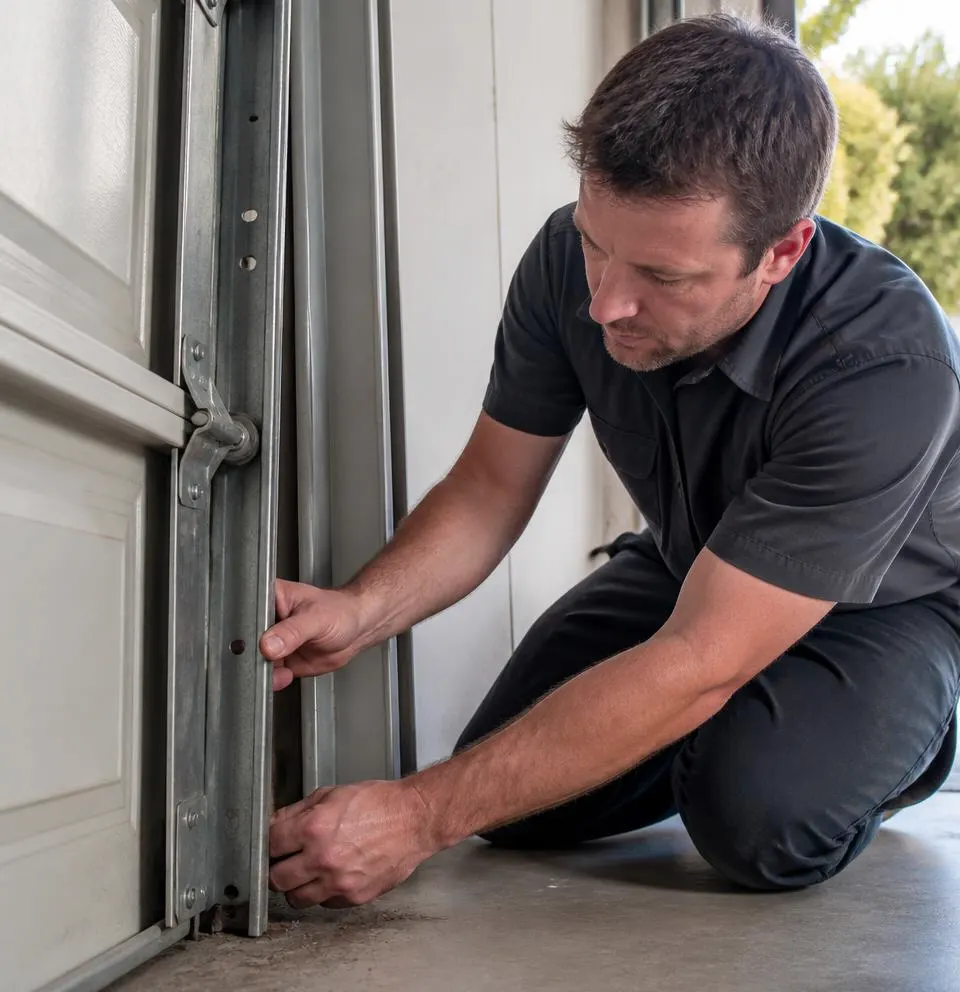
If the sensors look fine, the next place a technician looks is the track itself. A door that reverses partway down, especially with a grinding or catching sound, may be hitting an obstruction as it travels — pine straw, built-up grime, or small debris wedged in the channel.
During the occasional ice storms Sevier County sees in winter, moisture that gets into the track can freeze overnight, creating a ridge that stops the door cold. Clearing the track by hand and applying a proper garage door lubricant (not household grease, which attracts more dirt) to the rollers and hinges solves this in most cases.
Then: rollers, hinges, and track alignment
Worn or cracked rollers and a slightly bent track will make the door bind as it moves. The opener reads that resistance as an obstruction and reverses to protect against it, even though nothing is actually blocking the door. Years of humidity and summer rain exposure can rust brackets and pit rollers, so this becomes more common as a garage door ages. Look for door movement that's jerky or uneven rather than smooth, and check for visible gaps where the roller has popped out of the track.
If everything above checks out: the springs
Torsion and extension springs carry almost all of the door's weight. As they weaken, the opener has to work harder to move the door, and once it crosses the force threshold it either reverses the door or refuses to close it at all. A good way to spot this without opening the panel: disconnect the opener and try lifting the door by hand. If it feels heavy, drops on its own, or won't stay halfway up, the springs are worn.
This is not a repair to attempt yourself. Torsion springs in particular are under enough tension to cause serious injury if handled without the right tools and training.
Last check: the opener itself
If sensors, track, rollers, and springs all check out, an aging opener's logic board or force-sensing circuit may simply be misreading signals. Openers in the ten-plus-year range are more prone to this kind of intermittent fault, and at that point, replacement is often more reliable than continuing to chase the issue.
When to call Sevierville Garage Door
If you've cleaned the sensors and track and the door is still reversing or won't close, it's time to bring in a technician before the problem gets worse or leaves the door stuck open overnight. We check sensor alignment, inspect the track and rollers, and test spring balance as part of our garage door repair visits, and if the springs are the culprit, we handle garage door spring replacement on the spot with the right tools for safe removal. If the opener itself is the issue, our garage door opener repair and installation service can tell you whether a repair or a replacement makes more sense for your setup.
Call Sevierville Garage Door for fast, honest service anywhere in Sevierville, Pigeon Forge, Gatlinburg, Kodak, Dandridge, Newport, Jefferson City, or Strawberry Plains — we'll get your door closing right again.